
Ingress et Gateway API#
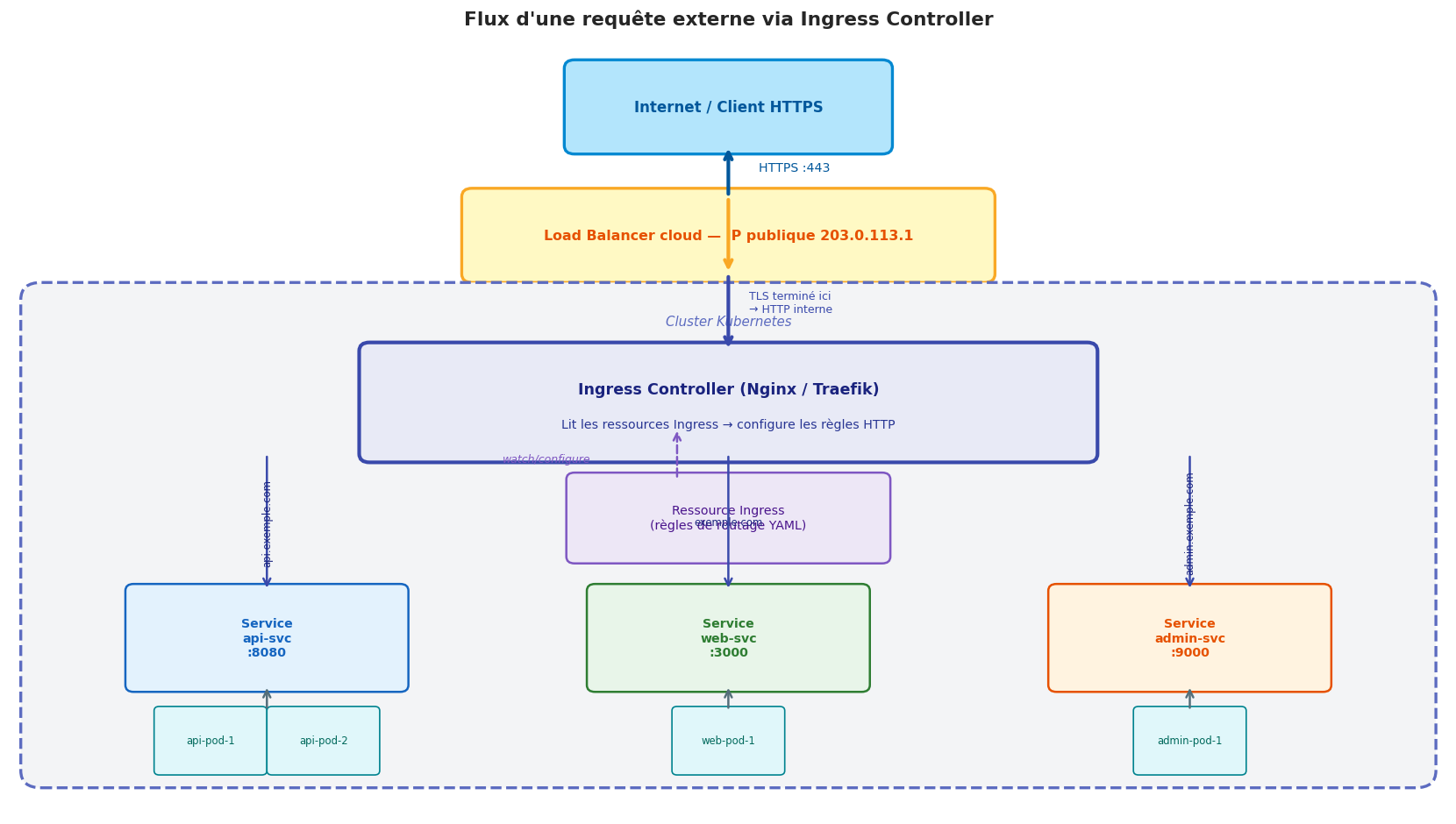
Vos applications tournent dans des Pods, exposées par des Services. Mais comment le trafic HTTP/HTTPS provenant d’Internet arrive-t-il jusqu’à elles ? C’est le rôle de l”Ingress et de la Gateway API, les deux mécanismes de Kubernetes pour exposer des services vers l’extérieur du cluster.
Le problème : exposer des services HTTP#
Sans Ingress, pour exposer une application web en HTTPS, vous devriez :
Créer un Service de type
LoadBalancerpour chaque application (un load balancer cloud par service = coûteux)Gérer les certificats TLS dans chaque application ou Service
Gérer le routage par host/path manuellement
L”Ingress centralise tout ça : un seul point d’entrée, des règles de routage déclaratives, et la terminaison TLS.
La ressource Ingress#
Un objet Ingress déclare les règles de routage HTTP : quel host et quel path doivent être redirigés vers quel Service.
# ingress-exemple.yaml
apiVersion: networking.k8s.io/v1
kind: Ingress
metadata:
  name: mon-ingress
  namespace: production
  annotations:
    # Annotations spécifiques au contrôleur Nginx
    nginx.ingress.kubernetes.io/rewrite-target: /
    nginx.ingress.kubernetes.io/proxy-body-size: "10m"
    nginx.ingress.kubernetes.io/rate-limit: "100"    # Requêtes/seconde
spec:
  # Classe d'Ingress Controller à utiliser
  ingressClassName: nginx

  # Configuration TLS
  tls:
    - hosts:
        - api.exemple.com
        - exemple.com
      secretName: tls-certificate   # Secret contenant le certificat

  # Règles de routage
  rules:
    # Routage par host
    - host: api.exemple.com
      http:
        paths:
          - path: /
            pathType: Prefix
            backend:
              service:
                name: api-svc
                port:
                  number: 8080

    - host: exemple.com
      http:
        paths:
          # Routage par path sur le même host
          - path: /app
            pathType: Prefix
            backend:
              service:
                name: web-svc
                port:
                  number: 3000
          - path: /api/v2
            pathType: Prefix
            backend:
              service:
                name: api-v2-svc
                port:
                  number: 8081
          # Catch-all : si aucun path ne correspond
          - path: /
            pathType: Prefix
            backend:
              service:
                name: default-svc
                port:
                  number: 80
Types de pathType#
Exact: correspondance exacte (/apine correspond pas à/api/v2)Prefix: correspondance par préfixe (/apicorrespond à/api/v2,/api/users…)ImplementationSpecific: comportement défini par le contrôleur
L’Ingress Controller : le composant qui fait le travail#
La ressource Ingress est juste un objet de configuration. Elle ne fait rien toute seule. Il faut déployer un Ingress Controller dans le cluster — c’est lui qui lit les ressources Ingress et configure réellement le proxy HTTP.
# Installer le contrôleur Nginx Ingress via Helm
helm repo add ingress-nginx https://kubernetes.github.io/ingress-nginx
helm repo update
helm install ingress-nginx ingress-nginx/ingress-nginx \
  --namespace ingress-nginx \
  --create-namespace \
  --set controller.replicaCount=2

# Vérifier l'installation
kubectl get pods -n ingress-nginx
kubectl get svc -n ingress-nginx
# service/ingress-nginx-controller   LoadBalancer  10.0.0.100  203.0.113.1  80:31080/TCP,443:31443/TCP
Ingress Controllers populaires :
Contrôleur |
Points forts |
|---|---|
Nginx Ingress |
Stable, très répandu, documentation riche |
Traefik |
Découverte automatique, dashboard intégré, Let’s Encrypt natif |
HAProxy |
Hautes performances, configurations avancées |
Contour |
Basé sur Envoy, gateway API ready |
Kong |
API Gateway features (auth, rate limiting, plugins) |
Annotations Nginx Ingress courantes#
annotations:
  # Réécriture de l'URL (ex: /api/v1/users → /users)
  nginx.ingress.kubernetes.io/rewrite-target: /$2

  # Authentification basique
  nginx.ingress.kubernetes.io/auth-type: basic
  nginx.ingress.kubernetes.io/auth-secret: basic-auth-secret

  # Rate limiting
  nginx.ingress.kubernetes.io/limit-rps: "10"

  # CORS
  nginx.ingress.kubernetes.io/enable-cors: "true"
  nginx.ingress.kubernetes.io/cors-allow-origin: "https://mon-frontend.com"

  # Timeout
  nginx.ingress.kubernetes.io/proxy-read-timeout: "60"
  nginx.ingress.kubernetes.io/proxy-send-timeout: "60"

  # Redirect HTTP → HTTPS
  nginx.ingress.kubernetes.io/ssl-redirect: "true"

  # Taille max du body (upload)
  nginx.ingress.kubernetes.io/proxy-body-size: "50m"
TLS avec Ingress et cert-manager#
Secret TLS manuel#
# Créer un Secret TLS à partir de fichiers certificat
kubectl create secret tls tls-certificate \
  --cert=certificat.crt \
  --key=cle-privee.key \
  --namespace production
cert-manager : automatisation des certificats#
cert-manager est un contrôleur Kubernetes qui automatise la gestion des certificats TLS, notamment avec Let’s Encrypt (certificats gratuits et renouvelés automatiquement).
# Installer cert-manager
kubectl apply -f https://github.com/cert-manager/cert-manager/releases/latest/download/cert-manager.yaml

# Vérifier
kubectl get pods -n cert-manager
# cluster-issuer-letsencrypt.yaml
# Émetteur de certificats Let's Encrypt (production)
apiVersion: cert-manager.io/v1
kind: ClusterIssuer
metadata:
  name: letsencrypt-prod
spec:
  acme:
    server: https://acme-v02.api.letsencrypt.org/directory
    email: admin@exemple.com    # Email pour les notifications d'expiration
    privateKeySecretRef:
      name: letsencrypt-prod-key
    solvers:
      - http01:
          ingress:
            class: nginx        # Utilise le challenge HTTP-01 via Ingress
# Ingress avec cert-manager (renouvellement automatique)
apiVersion: networking.k8s.io/v1
kind: Ingress
metadata:
  name: mon-ingress-tls
  annotations:
    cert-manager.io/cluster-issuer: "letsencrypt-prod"  # Clé magique !
spec:
  ingressClassName: nginx
  tls:
    - hosts:
        - exemple.com
      secretName: exemple-com-tls   # cert-manager crée ce Secret automatiquement
  rules:
    - host: exemple.com
      http:
        paths:
          - path: /
            pathType: Prefix
            backend:
              service:
                name: web-svc
                port:
                  number: 80
Cycle de vie d’un certificat avec cert-manager
cert-manager détecte l’annotation
cert-manager.io/cluster-issuerIl crée un objet
CertificateRequestet contacte Let’s EncryptLet’s Encrypt vérifie que vous contrôlez le domaine (challenge HTTP-01 ou DNS-01)
cert-manager reçoit le certificat et le stocke dans le Secret indiqué
cert-manager surveille l’expiration (30 jours avant) et renouvelle automatiquement
Gateway API : la nouvelle génération#
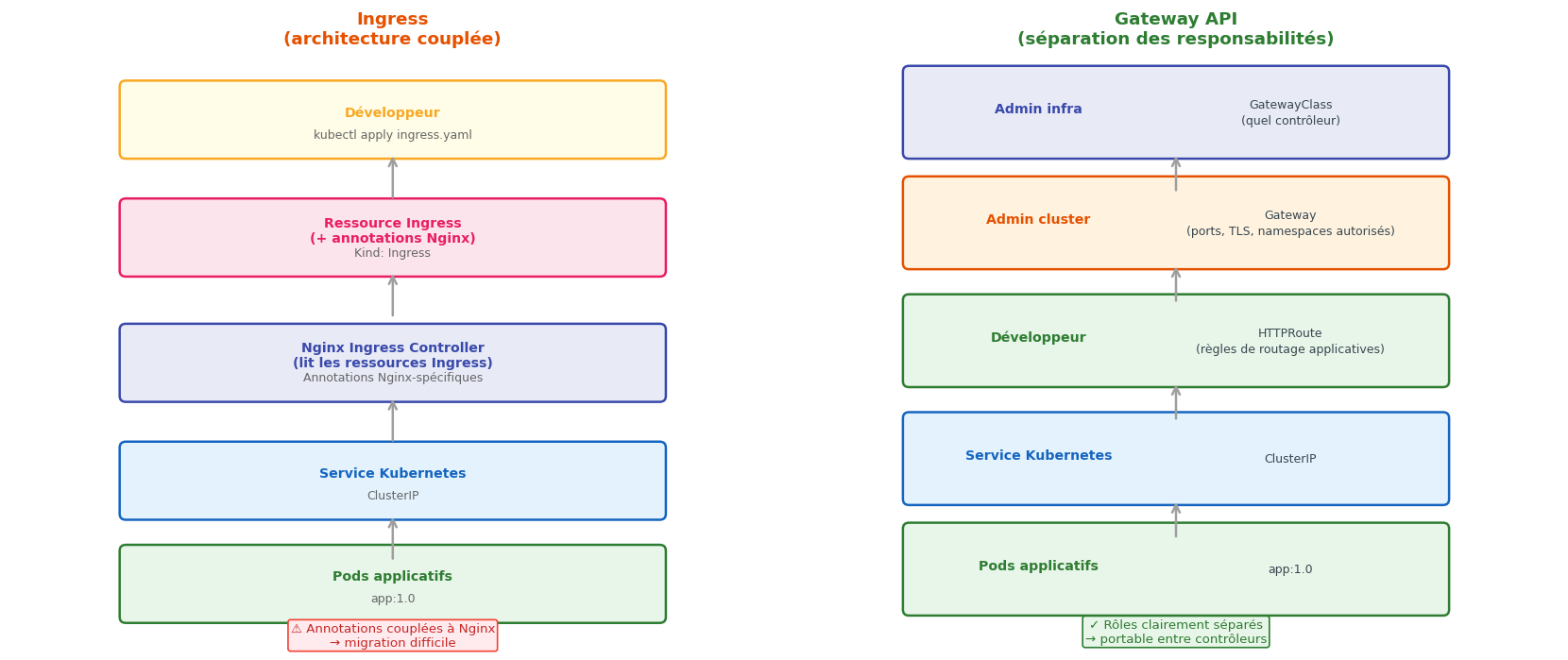
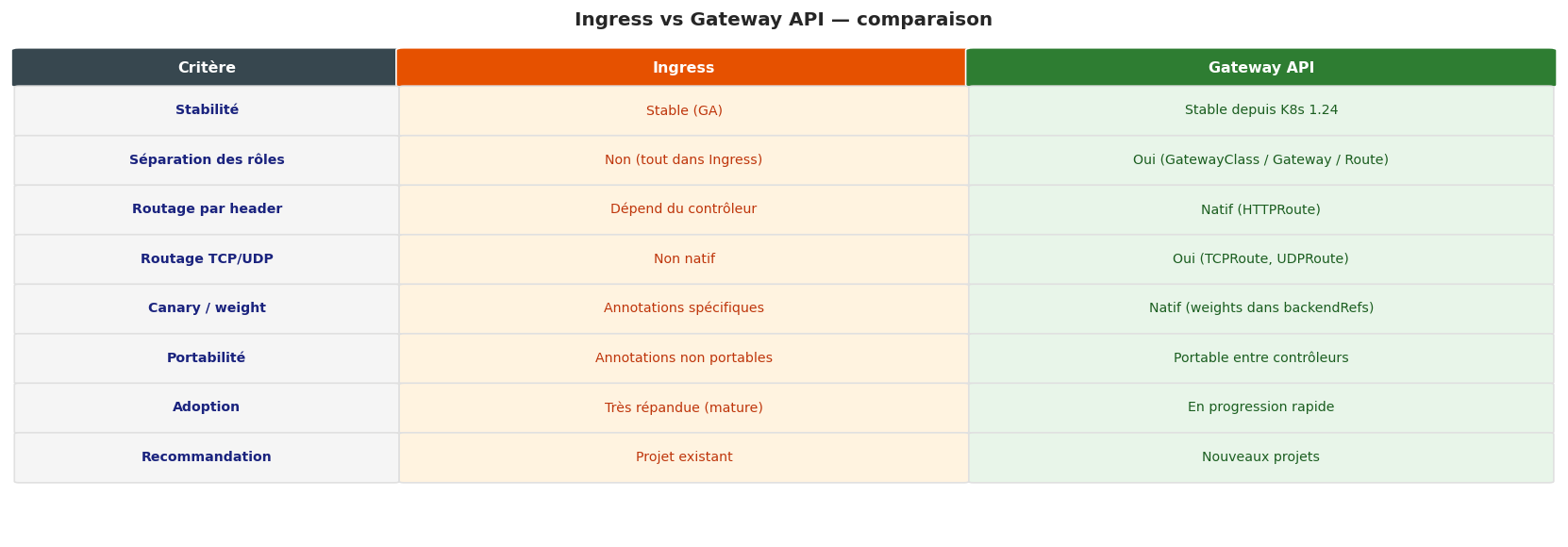
La Gateway API est la successeure de l’Ingress. Elle résout plusieurs limitations de l’Ingress :
L’Ingress est trop couplé à Nginx (annotations spécifiques au contrôleur)
Pas de support natif pour le routage TCP/UDP
Séparation des responsabilités floue (infrastructure vs application)
La Gateway API introduit trois ressources distinctes avec des responsabilités claires :
Ressource |
Qui la gère |
Rôle |
|---|---|---|
|
Admin infrastructure |
Définit quel contrôleur utiliser (Nginx, Envoy…) |
|
Admin cluster |
Configure le point d’entrée (ports, TLS, protocoles) |
|
Développeur |
Définit les règles de routage de l’application |
# gatewayclass.yaml (géré par l'admin infra)
apiVersion: gateway.networking.k8s.io/v1
kind: GatewayClass
metadata:
  name: nginx-gateway
spec:
  controllerName: k8s.nginx.org/nginx-gateway-controller
# gateway.yaml (géré par l'admin cluster)
apiVersion: gateway.networking.k8s.io/v1
kind: Gateway
metadata:
  name: passerelle-prod
  namespace: infra
spec:
  gatewayClassName: nginx-gateway
  listeners:
    - name: https
      protocol: HTTPS
      port: 443
      tls:
        mode: Terminate
        certificateRefs:
          - name: tls-wildcard-cert
      allowedRoutes:
        namespaces:
          from: Selector
          selector:
            matchLabels:
              gateway: autorisee   # Seuls les namespaces avec ce label peuvent y accéder
# httproute.yaml (géré par le développeur)
apiVersion: gateway.networking.k8s.io/v1
kind: HTTPRoute
metadata:
  name: route-api
  namespace: production
spec:
  parentRefs:
    - name: passerelle-prod
      namespace: infra
  hostnames:
    - "api.exemple.com"
  rules:
    - matches:
        - path:
            type: PathPrefix
            value: /v2
      backendRefs:
        - name: api-v2-svc
          port: 8080
          weight: 90       # 90% du trafic (canary deployment !)
        - name: api-v3-canary-svc
          port: 8080
          weight: 10       # 10% vers la nouvelle version

    - matches:
        - headers:
            - name: "x-beta-user"
              value: "true"  # Routage par header (feature flag)
      backendRefs:
        - name: api-beta-svc
          port: 8080
Simulation Python : routeur Ingress#
from dataclasses import dataclass, field
from typing import List, Optional, Tuple
import re

@dataclass
class RegleIngress:
    """Représente une règle de routage Ingress."""
    host: str
    path: str
    path_type: str          # Exact, Prefix
    service_nom: str
    service_port: int
    priorite: int = 0       # Plus bas = plus prioritaire

    def correspond(self, host: str, path: str) -> bool:
        """Vérifie si une requête correspond à cette règle."""
        # Vérification du host (wildcards supportés : *.exemple.com)
        if self.host.startswith("*."):
            domaine = self.host[2:]
            if not (host.endswith("." + domaine) or host == domaine):
                return False
        elif self.host != "*" and self.host != host:
            return False

        # Vérification du path
        if self.path_type == "Exact":
            return path == self.path
        elif self.path_type == "Prefix":
            return path == self.path or path.startswith(self.path.rstrip("/") + "/")
        return False


@dataclass
class RouterIngress:
    """Simulation d'un routeur Ingress (comme nginx-ingress-controller)."""
    nom: str
    regles: List[RegleIngress] = field(default_factory=list)

    def ajouter_regle(self, regle: RegleIngress):
        self.regles.append(regle)
        # Trier par priorité puis par longueur de path (plus long = plus spécifique)
        self.regles.sort(key=lambda r: (r.priorite, -len(r.path)))

    def router(self, host: str, path: str) -> Optional[Tuple[str, int, str]]:
        """
        Route une requête vers le service approprié.
        Retourne (service_nom, service_port, regle_matchée) ou None.
        """
        for regle in self.regles:
            if regle.correspond(host, path):
                return regle.service_nom, regle.service_port, f"{regle.host}{regle.path}"
        return None

    def tester(self, requetes: List[Tuple[str, str]]):
        """Teste une liste de requêtes et affiche le résultat."""
        print(f"\nRouteur Ingress : {self.nom}")
        print(f"{'Requête':<45} {'Résultat'}")
        print("-" * 75)
        for host, path in requetes:
            resultat = self.router(host, path)
            url = f"{host}{path}"
            if resultat:
                svc, port, regle = resultat
                print(f"  {url:<43} → {svc}:{port}  (via règle '{regle}')")
            else:
                print(f"  {url:<43} → ✗ 404 Not Found (aucune règle ne correspond)")


# Construire un routeur Ingress de démonstration
routeur = RouterIngress("ingress-production")

# Ajouter les règles (de la plus spécifique à la moins spécifique)
routeur.ajouter_regle(RegleIngress("api.exemple.com", "/v2/users", "Exact",    "api-v2-svc", 8081))
routeur.ajouter_regle(RegleIngress("api.exemple.com", "/v2",       "Prefix",   "api-v2-svc", 8081))
routeur.ajouter_regle(RegleIngress("api.exemple.com", "/",         "Prefix",   "api-v1-svc", 8080))
routeur.ajouter_regle(RegleIngress("exemple.com",     "/app",      "Prefix",   "web-svc",    3000))
routeur.ajouter_regle(RegleIngress("exemple.com",     "/admin",    "Prefix",   "admin-svc",  9000))
routeur.ajouter_regle(RegleIngress("exemple.com",     "/",         "Prefix",   "homepage-svc", 80))
routeur.ajouter_regle(RegleIngress("*.exemple.com",   "/health",   "Exact",    "healthcheck-svc", 8888))

# Tests
requetes_test = [
    ("api.exemple.com",   "/v2/users"),          # Exact match
    ("api.exemple.com",   "/v2/orders/123"),     # Prefix /v2
    ("api.exemple.com",   "/v1/legacy"),         # Prefix /
    ("exemple.com",       "/app/dashboard"),     # Prefix /app
    ("exemple.com",       "/admin/users"),       # Prefix /admin
    ("exemple.com",       "/"),                  # Catch-all
    ("blog.exemple.com",  "/health"),            # Wildcard host
    ("autre-domaine.io",  "/api"),               # Pas de règle
    ("exemple.com",       "/inexistant/page"),   # Path inexistant → catch-all /
]

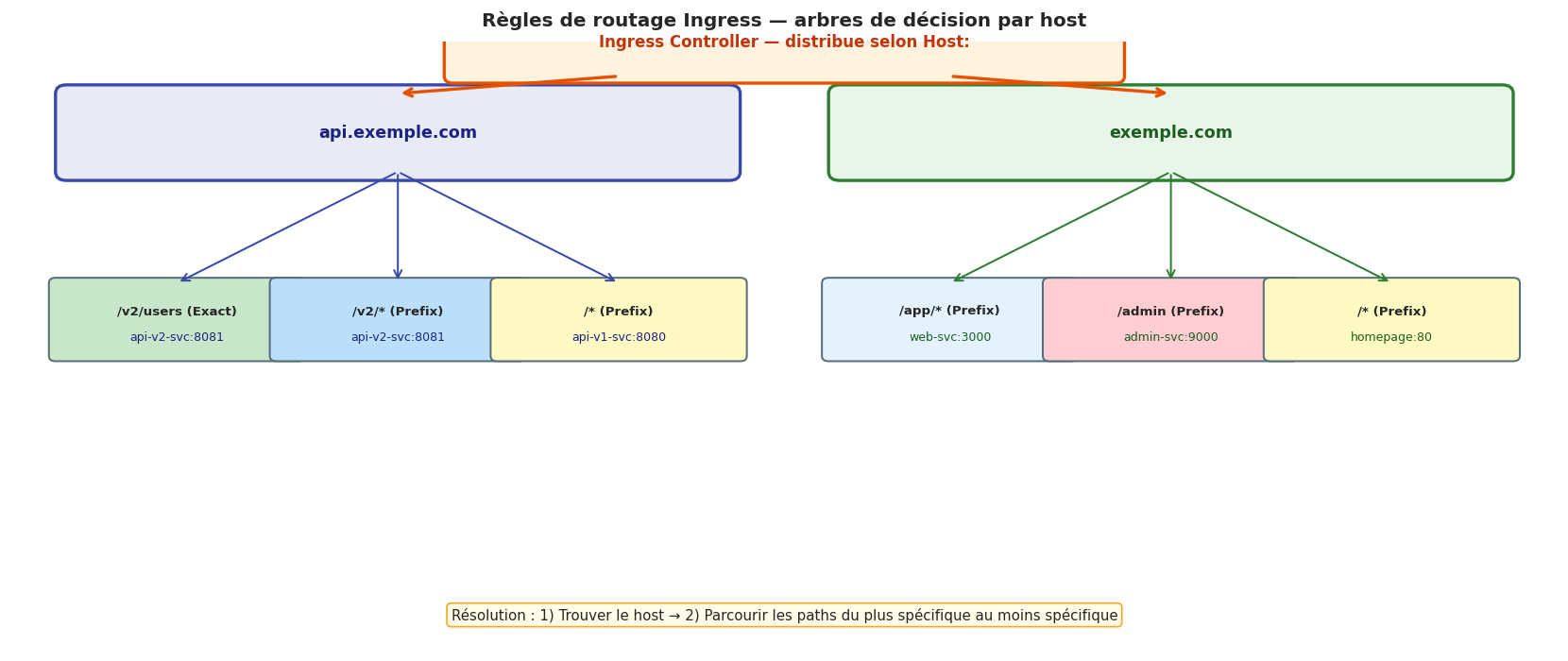
routeur.tester(requetes_test)
Routeur Ingress : ingress-production
Requête                                       Résultat
---------------------------------------------------------------------------
  api.exemple.com/v2/users                    → api-v2-svc:8081  (via règle 'api.exemple.com/v2/users')
  api.exemple.com/v2/orders/123               → api-v2-svc:8081  (via règle 'api.exemple.com/v2')
  api.exemple.com/v1/legacy                   → api-v1-svc:8080  (via règle 'api.exemple.com/')
  exemple.com/app/dashboard                   → web-svc:3000  (via règle 'exemple.com/app')
  exemple.com/admin/users                     → admin-svc:9000  (via règle 'exemple.com/admin')
  exemple.com/                                → homepage-svc:80  (via règle 'exemple.com/')
  blog.exemple.com/health                     → healthcheck-svc:8888  (via règle '*.exemple.com/health')
  autre-domaine.io/api                        → ✗ 404 Not Found (aucune règle ne correspond)
  exemple.com/inexistant/page                 → homepage-svc:80  (via règle 'exemple.com/')
Ingress vs Gateway API : tableau comparatif#
Points clés à retenir#
L”Ingress centralise l’exposition HTTP/HTTPS : un seul point d’entrée pour plusieurs applications
L”Ingress Controller (Nginx, Traefik…) est le composant qui lit les ressources Ingress et fait réellement le routage — il faut l’installer séparément
Les règles de routage combinent host et path : la règle la plus spécifique (path le plus long) est appliquée en premier
cert-manager automatise la gestion des certificats TLS avec Let’s Encrypt (renouvellement automatique)
La Gateway API est la nouvelle génération : elle sépare les responsabilités (infra / cluster / dev) et supporte nativement le routage TCP/UDP, les poids de trafic (canary), et le routage par header
Pour les nouveaux projets, préférer la Gateway API ; l’Ingress reste pertinent pour les projets existants